The Executive AI Governance Checklist: What to Review Before Scaling Automation

Updated: 5 days ago
AI governance becomes expensive when it starts too late. A team builds a promising pilot, leadership announces the opportunity, and only then do privacy, security, legal, risk, data, and operations leaders discover unresolved issues that change the scope, cost, or feasibility.
Strong governance does not exist to slow AI down. It helps the organization move faster with clear boundaries, named owners, evidence requirements, and escalation paths. It also protects the value case from risks that can erase financial benefit after launch.

An executive AI governance checklist turns broad principles into funding and scaling decisions. It tells leadership what must be known, who must approve, what evidence must be produced, and which gaps can be accepted temporarily under controlled conditions.
AI Governance Checklist: Why Governance Belongs on the Executive Agenda
AI systems influence decisions, customer interactions, employee work, data use, financial outcomes, and operational processes. The consequences are not confined to the technology function. Accountability therefore cannot be delegated entirely to a model team or vendor.
Morgan Stanley’s 2026 analysis found that boards are building deeper AI expertise, while surveyed governance executives identify data risk as a leading concern and emphasize human review for higher-risk situations. Those findings reflect a broader shift: governance is becoming an operating responsibility, not a policy document.
NIST’s AI Risk Management Framework is designed to help organizations govern, map, measure, and manage AI risk throughout the lifecycle. Executives do not need to turn every initiative into a compliance program, but they do need a consistent way to determine materiality and control depth.
Start with business purpose and materiality
Every initiative should have a documented business purpose, intended users, affected stakeholders, and decision boundary. A system that drafts internal summaries carries different risk from a system that recommends credit decisions, changes prices, interacts with customers, or initiates financial transactions.
Classify the initiative by materiality. Consider financial impact, customer impact, legal or regulatory exposure, sensitivity of data, autonomy, reversibility, scale, and the consequences of error.
Governance should be proportional. Low-risk internal tools may use lightweight controls. High-impact or autonomous systems require stronger testing, approvals, monitoring, and human intervention.
1. Executive ownership
Name one accountable executive for the business outcome and one operational owner for day-to-day performance. A committee can provide oversight, but it cannot substitute for clear accountability.
The executive owner should approve the intended use, risk tolerance, funding stage, success measures, and conditions for expansion or shutdown. The operational owner should maintain documentation, coordinate controls, monitor results, and escalate issues.
2. Data rights, quality, and lineage
Confirm that the organization has the right to use every material data source for the intended purpose. Review consent, contractual restrictions, confidentiality, retention, residency, and intellectual-property considerations.
Assess data quality against the actual use case. Data can be accurate enough for reporting yet unsuitable for automated recommendations. Identify missing populations, outdated fields, inconsistent labels, and proxies that may create unfair outcomes.
Maintain lineage so leaders can understand where important data came from, how it was transformed, and which model or workflow used it. If the evidence cannot be reconstructed, the organization may not be able to defend or correct the result.
3. Privacy and security
Document the sensitive information the system can access, generate, infer, or expose. Apply least-privilege access, approved environments, encryption, logging, retention controls, and incident-response procedures.
Evaluate prompt injection, data leakage, unauthorized tool use, insecure integrations, credential exposure, and the risk that an agent takes action beyond its approved scope. Security review should cover the full workflow, not only the underlying model.
Define what information must never be entered into an external system and how violations will be detected and handled.
4. Model and output risk
Set quality thresholds based on the business consequence of error. Accuracy alone may be insufficient. Review hallucination, bias, drift, robustness, explainability, consistency, and performance across relevant groups and conditions.
Create an evaluation set that represents real work. Vendor demonstrations and generic benchmarks do not prove performance in the organization’s data, policies, terminology, and edge cases.
Specify which outputs require verification, which sources must be cited, and when the system must decline, escalate, or request more information.
5. Human oversight and decision rights
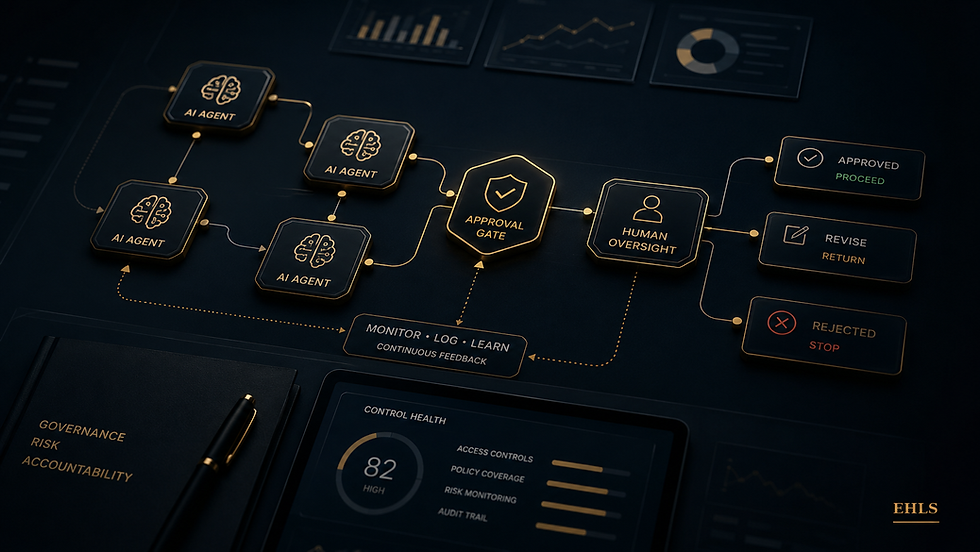
Human oversight must be more specific than “a person is in the loop.” Identify the role, authority, information, and time available to review the system’s work.
Decide whether the human approves before action, reviews after action, monitors exceptions, or can override and reverse the result. High-risk workflows often need independent review rather than the same person who benefits from speed.
Train reviewers to recognize failure modes. A human who routinely accepts AI output without meaningful examination is not an effective control.
6. Vendor and third-party risk
Understand the vendor’s data use, retention, model-improvement practices, subprocessors, security controls, service levels, incident notification, audit rights, pricing model, and exit terms.
Ask what happens when the vendor changes a model, feature, policy, or price. A system may behave differently even when the organization has not changed its own code.
Maintain an alternative plan for critical workflows. Vendor dependence becomes an operational risk when the organization cannot export data, reproduce decisions, or transition without major disruption.
7. Legal, regulatory, and policy review
Map applicable laws, regulations, contractual obligations, industry standards, internal policies, and employment requirements. The relevant rules depend on the use case, geography, affected people, and sector.
Do not treat the absence of an AI-specific law as the absence of obligation. Existing rules on privacy, discrimination, consumer protection, records, cybersecurity, financial controls, and professional responsibility may still apply.
Record the legal interpretation and the conditions under which it must be revisited. Regulatory uncertainty should produce monitoring and escalation—not an undocumented assumption.
8. Change management and user adoption
Governance includes how people use the system. Define approved uses, prohibited uses, training, support, feedback, accountability, and consequences for bypassing controls.
Redesign the workflow rather than adding AI to a broken process. Clarify which tasks change, which decisions remain human, how exceptions are handled, and how performance is measured.
Monitor shadow AI and redundant tools. Unmanaged adoption can create data exposure, inconsistent outputs, duplicated cost, and a fragmented control environment.
9. Monitoring, logging, and evidence
Before launch, define what will be monitored, how often, by whom, and what thresholds trigger action. Track value, quality, risk, adoption, cost, incidents, overrides, and complaints.
Logs should be sufficient to investigate significant decisions and failures while respecting privacy and retention requirements. For agentic systems, record tool calls, approvals, external actions, and changes to important data.
Monitoring is not only technical. Finance should review value realization, operations should review process outcomes, and risk owners should review control performance.
10. Incident response and shutdown authority
Create a response plan for harmful output, data exposure, security compromise, unexpected behavior, regulatory concern, vendor failure, or material financial loss.
Name who can pause the system, who must be notified, how affected parties are protected, how evidence is preserved, and how the organization decides whether to restart.
Use stage gates instead of one permanent approval
AI initiatives change between discovery, pilot, limited production, and scale. Governance should use stage-specific approvals rather than one decision that is assumed to remain valid forever.
At discovery, confirm purpose, ownership, data feasibility, and material risks. Before a pilot, approve the test population, controls, evaluation plan, and stop conditions. Before production, require performance evidence, operational readiness, monitoring, support, and incident response. Before scale, review realized value, control effectiveness, adoption, cost, and new exposure.
Stage gates keep oversight proportional while preventing a successful small pilot from becoming uncontrolled enterprise deployment.
Connect governance to the value case
Governance work affects cost, time to value, and feasibility. Include data remediation, security controls, legal review, evaluation, monitoring, training, and support in the AI ROI model.
A project with attractive gross benefit may become less compelling when required controls are considered. That does not mean governance destroyed value. It means the original forecast excluded the true cost of responsible operation.
Use the related AI ROI calculator guide to incorporate those costs, and use the AI value scorecard guide to compare the resulting opportunity with other investments.
Frequently asked executive questions
What AI governance controls are required before scaling? Require a named owner, risk classification, data rights, testing, human oversight, logging, monitoring, incident response, and tested shutdown authority.
Who should own AI risk and approval decisions? The executive sponsor owns the business outcome while legal, security, privacy, finance, and operational owners approve the controls within their authority.
How often should executive teams review AI controls? Review before launch, after material model or workflow changes, at funding stage gates, and at least quarterly for material systems.
A 90-day governance implementation sequence
In the first 30 days, inventory the highest-impact AI use cases, assign owners, classify materiality, and document the data and systems involved. Resolve obvious prohibited uses and identify the controls required before testing.
In days 31 through 60, build the evaluation set, complete privacy and security review, define human oversight, confirm vendor terms, and run a controlled pilot with logging enabled. Review both value and failure evidence.
In days 61 through 90, assess results against the approved thresholds, close critical gaps, train operational users, finalize monitoring, and present a scale, extend, redesign, or stop recommendation. This sequence gives executives a practical path from policy to operating control.
Common governance mistakes
The first mistake is copying a broad policy without translating it into roles, evidence, and decisions. The second is treating vendor assurances as the organization’s risk assessment. The third is requiring human review without defining its authority or quality.
Other mistakes include approving a pilot without stop conditions, ignoring operational adoption, failing to monitor cost, allowing undocumented model changes, and separating governance from financial planning.
Governance becomes useful when it changes behavior: weak proposals are redesigned, controls are funded, ownership is assigned, evidence is produced, and unsafe or low-value systems are stopped.
Use a practical governance toolkit
The Executive AI Value Scorecard Toolkit includes a governance and readiness checklist alongside the weighted scorecard, ROI and payback calculator, 90-day roadmap, executive summary, board presentation template, quick-start guide, and completed example.
It helps leadership teams evaluate opportunities and controls in one decision process. Use it before approving a pilot, expanding automation, renewing an AI vendor, or presenting an investment recommendation to the board.
Final thought
AI governance is not a promise that nothing will go wrong. It is the operating discipline that makes risks visible, assigns authority, creates evidence, and enables fast correction.
The organizations that scale AI with confidence will be able to answer two questions at the same time: Is this initiative creating measurable value, and are we operating it within an acceptable, monitored risk boundary?
Continue the executive AI decision series
How to Build an AI Value Scorecard the Board Will Trust — compare AI opportunities using one executive framework for value, readiness, ownership, and risk.
AI ROI Calculator for Executives — include the full cost of governance, calculate payback, and compare projects consistently.
Research referenced
NIST AI Risk Management Framework — A voluntary framework for governing, mapping, measuring, and managing AI risk.
NIST Generative AI Profile — Companion guidance for risks that are distinctive to or intensified by generative AI.
Morgan Stanley: AI governance adoption report — 2026 analysis of board expertise, data risk, model risk, regulation, and human review.


Comments