AI Governance: How Executives Close the Agent Control Gap Before Scaling Automation

Updated: 5 days ago
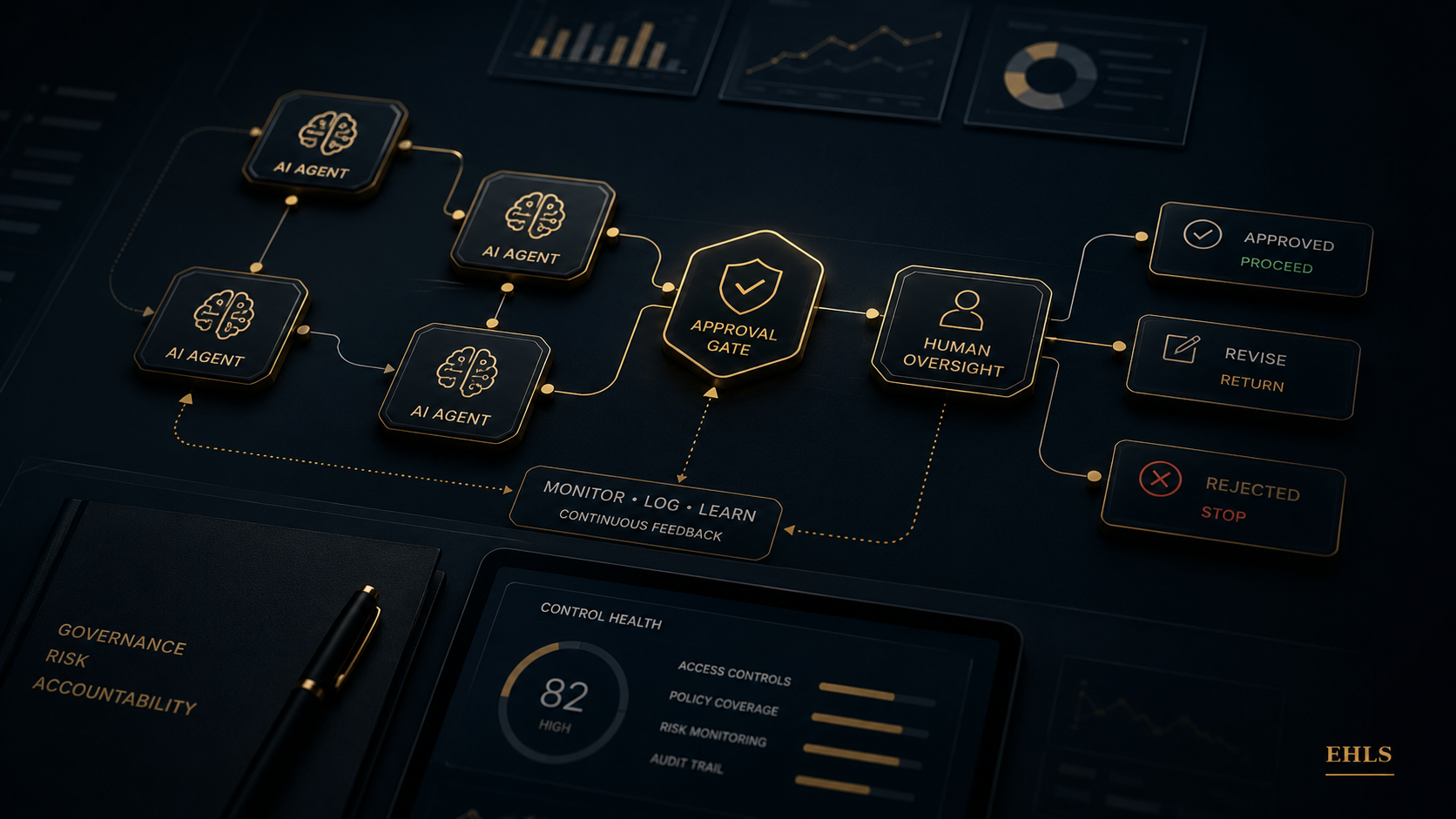
Executive answer
AI agents should not receive broad autonomy until leadership can see every delegated action, limit permissions, require human approval for high-consequence steps, preserve logs, and stop the workflow quickly. Use proportional control: automate reversible, low-risk work and gate actions involving customers, money, sensitive data, legal obligations, or core operations. Each agent needs a named owner, explicit authority boundaries, monitoring, incident response, and a recurring review tied to business value.
Why familiar software controls are not enough
Traditional applications generally execute predefined logic. AI agents can interpret instructions, select tools, plan multiple steps, and respond to changing context. Their behavior can vary even when the goal appears similar. That flexibility is the source of value and the reason controls must address more than code quality or user access. Leadership must govern the decisions an agent may make inside the permissions it has been granted.
An agent may technically have permission to use a system while still making an inappropriate decision about when, why, or how to use it. It may combine individually harmless data in a sensitive way, follow a malicious instruction embedded in retrieved content, escalate a minor error through multiple systems, or produce a customer-facing action that is difficult to reverse. AI governance must therefore govern goals, context, tools, data, decisions, and outcomes.
Start with an inventory of agents and delegated authority
Leadership cannot govern what it cannot see. Every deployed or experimental agent should be recorded with an owner, purpose, users, connected systems, accessible data, permitted actions, decision boundaries, model dependencies, business criticality, and current status. The inventory should include agents built by central technology teams, embedded in vendor products, created by departments, and assembled through low-code tools. Shadow automation can create material exposure even when no one intended to deploy an agent formally.
The most important field is delegated authority. Executives need to know what the agent can observe, recommend, create, modify, communicate, approve, purchase, delete, or trigger. Two agents that use the same model may have radically different risk because one drafts internal notes while the other changes customer records or sends binding communications. Governance should be based on capability and consequence, not on the brand name of the model.
Classify actions by consequence and reversibility
A practical control framework classifies actions by financial impact, customer impact, legal or regulatory exposure, data sensitivity, operational disruption, and reversibility. Low-consequence, reversible actions may run automatically with logging. Moderate-consequence actions may require thresholds, sampling, or post-action review. High-consequence or difficult-to-reverse actions may require explicit human authorization. This approach avoids applying the same burden to every workflow.
The classification should be applied to specific actions, not broad agent labels. The same agent may be allowed to retrieve account history automatically, draft a recommendation with review, and be prohibited from changing commercial terms. Fine-grained authority preserves useful automation while limiting the pathways that could create disproportionate harm. It also lets the company expand autonomy gradually as reliability is demonstrated.
Use least privilege for tools, data, and time
Agents should receive only the permissions needed for the current task. Avoid persistent, broad credentials when scoped or temporary access is possible. Separate read access from write access, restrict high-risk tools, limit transaction values, constrain the records an agent can affect, and expire permissions when the workflow ends. This reduces the impact of mistakes, compromised instructions, and unintended tool selection.
Data access also requires purpose limits. An agent may be authorized to use customer data for service support but not for unrelated profiling or external communication. Governance should define not only which data is accessible, but which combinations, transformations, and uses are acceptable for the business purpose. Sensitive derived information can be as consequential as the original record.
Define human decision points before deployment
Human oversight should be designed into the workflow rather than added after an incident. Specify where a person must approve, where a person may intervene, what evidence the reviewer receives, how quickly a decision is required, and what happens if no reviewer responds. A nominal approval step is ineffective if the reviewer lacks context or is pressured to approve large volumes without meaningful evaluation.
Executives should distinguish human-in-the-loop from human-on-the-loop controls. Some workflows require approval before action. Others can operate automatically while trained owners monitor performance, review exceptions, and retain immediate shutdown authority. The correct pattern depends on consequence, speed requirements, reliability, and reversibility. The choice should be documented rather than left to each team’s preference.
Create explicit policies for instructions and tool use
Agents need operational policies that translate governance into executable boundaries. Policies may restrict destinations, transaction sizes, customer segments, content types, hours of operation, system combinations, or actions that require confirmation. They should also define how the agent handles conflicting instructions, uncertain data, missing context, and requests that exceed its authority. Policies must be testable and visible to the owners responsible for the outcome.
Retrieved content should be treated as untrusted input. Documents, web pages, emails, tickets, and user messages can contain instructions that attempt to redirect an agent. The system should separate authoritative instructions from external content, validate tool arguments, and prevent retrieved text from silently expanding the agent’s authority. High-risk actions should be checked against policy independently of the model’s own reasoning.
Test behavior, not only model accuracy
Agent testing should cover complete workflows and adverse conditions. Evaluate whether the agent chooses the correct tool, stays within permission boundaries, handles ambiguous instructions, resists manipulation, preserves data integrity, escalates uncertainty, and recovers from partial failures. Test what happens when a downstream system is unavailable, a record conflicts with another source, or a human changes the environment mid-task. Reliability is a property of the whole system, not only the model.
Red-team exercises should reflect realistic business scenarios, including fraudulent requests, sensitive customer situations, unusual transaction patterns, and attempts to make the agent bypass policy. The purpose is not to prove that the system can never fail. It is to understand failure modes, reduce their likelihood, limit their impact, and ensure the organization can respond. Findings should feed directly into permissions, policies, monitoring, and workflow redesign.
Make every consequential action observable
Executives need an audit trail that reconstructs what the agent was asked to do, what context it used, which tools it selected, what actions it attempted, what approvals occurred, what result was produced, and which policies were triggered. Logs should be useful to operations, security, compliance, and business owners—not merely stored for technical troubleshooting. The organization should be able to answer what happened without relying on the agent to explain itself after the fact.
Monitoring should combine technical and business indicators. Technical metrics may include failures, latency, policy violations, unusual tool sequences, and model changes. Business metrics may include incorrect decisions, customer complaints, financial exceptions, conversion effects, manual overrides, and downstream rework. An agent can be technically healthy while creating a poor business outcome, so operational dashboards must include the result leadership actually cares about.
Prepare an escalation and shutdown system
Every material agent should have a named operational owner, an incident path, and a tested method to restrict or disable actions. The organization should know who can revoke credentials, pause workflows, roll back changes, notify affected teams, preserve evidence, and decide when the agent may resume. Shutdown authority must be available at the speed of the automated workflow. A process that requires several meetings is not an effective emergency control.
Incident planning should account for chains of agents and systems. Stopping one component may not reverse actions already triggered elsewhere. Controls should support transaction limits, staged execution, idempotency, reconciliation, and compensating actions so the organization can contain a problem without creating additional damage. Teams should rehearse the response before the workflow reaches broad scale.
Govern change across models, prompts, tools, and vendors
Agent behavior can change when the underlying model, prompt, knowledge source, tool integration, policy, or vendor service changes. Material changes should trigger testing and approval appropriate to the risk level. Vendor updates should not silently alter the behavior of a revenue-critical process without visibility and accountability. Change management must include the AI components that influence decisions, not only traditional application releases.
Maintain version records and compare performance before and after changes. Where possible, use controlled rollouts, limited populations, transaction caps, and rollback plans. This creates a safe path for improvement without freezing the system in its initial state. The organization can benefit from better models and tools while maintaining confidence that critical controls still work.
A 90-day plan for closing the agent control gap
The first 30 days should establish visibility. Inventory agents, embedded vendor capabilities, low-code automations, connected systems, data access, action permissions, owners, and business criticality. Identify any agent that can communicate externally, change records, move money, alter customer terms, delete information, or trigger downstream systems. Those capabilities deserve immediate review because their consequences may exceed the controls originally designed for a simple assistant.
During days 31 through 60, classify consequential actions and implement proportionate controls. Separate read from write permissions, apply transaction and scope limits, define approval points, establish policy checks, create monitoring requirements, and document shutdown procedures. Test the most important workflows under normal, ambiguous, and adversarial conditions. Include frontline operators because they often understand practical failure modes that are invisible in architecture diagrams or vendor demonstrations.
During days 61 through 90, run a controlled scale review. Examine business outcomes, overrides, exceptions, near misses, customer effects, policy violations, and operational friction. Decide where the agent has earned greater autonomy, where controls should remain, and where the workflow needs redesign. Confirm that any model, prompt, tool, or vendor change will trigger an appropriate retest. This converts governance from a launch checklist into an operating capability.
Connect AI governance to business value
Governance should help the company scale valuable automation with confidence. Excessively broad restrictions can prevent adoption, while weak controls can produce incidents that destroy trust and delay the entire program. The executive objective is proportional control: stronger safeguards where consequences are high and streamlined controls where risk is limited. Reliable control increases the amount of authority leadership can safely delegate.
The companies that benefit most from agents will not be those that avoid risk or automate everything. They will be those that deliberately decide where autonomy creates value, build controls into the operating design, and maintain enough visibility to increase authority as evidence improves. That combination turns governance from a defensive function into a strategic capability for faster, safer growth.
Frequently asked executive questions
Which AI agent actions require human approval? Require approval for actions that move money, change customer terms, expose sensitive data, make regulated decisions, or are difficult to reverse.
How should an organization stop or contain an AI agent? Use revocable credentials, transaction limits, pause controls, a named incident owner, and tested rollback or compensating actions.
What logs are required for executive oversight of AI agents? Capture instructions, context, tools called, data accessed, decisions, approvals, outputs, exceptions, and downstream actions.
Next executive step
Why AI Investments Stall Before ROI — connect delegated authority and governance to an operating model that produces measurable value.
Use the Executive AI Value Scorecard Toolkit to compare the value, readiness, governance, and risk of agent initiatives before approving broader autonomy.


Comments