AI ROI: Why Investments Stall—and the Executive Operating Model That Fixes It

Updated: 5 days ago
Executive answer
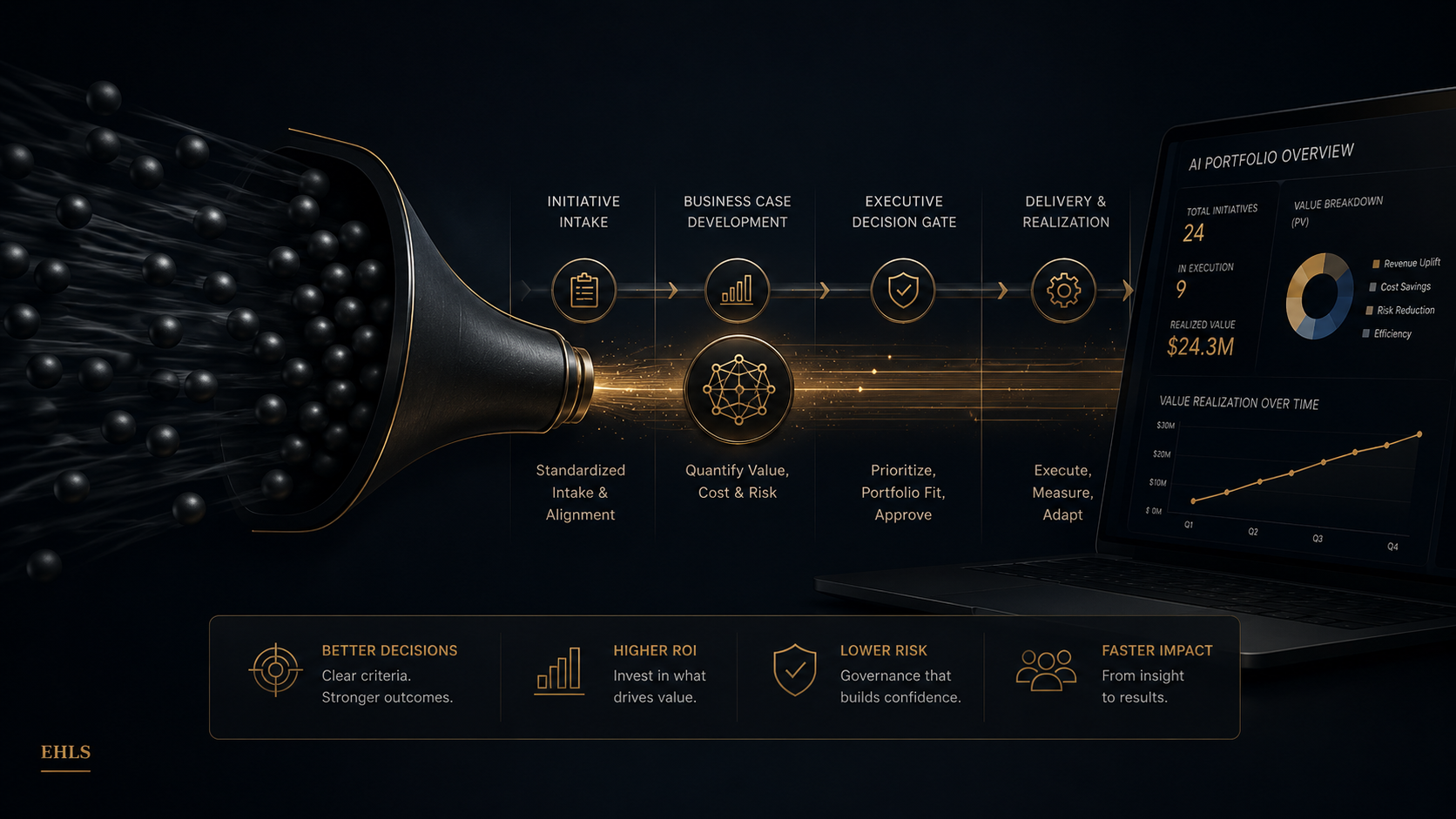
AI ROI stalls when a pilot proves technical capability but never changes the workflow, adoption, accountability, or financial mechanism. The fix is an operating model that begins with a value thesis, assigns one outcome owner, funds a prioritized portfolio, redesigns work, validates economics, and uses stage gates to scale, repair, or stop. Technology activity matters only when it produces revenue, margin, cost, speed, risk, or decision-quality gains.
Why AI ROI stalls even when pilots look successful
Many pilots are designed to prove that a model can perform a task. That is not the same as proving economic value. A team may demonstrate that an assistant summarizes reports, drafts proposals, predicts demand, or answers customer questions. The demonstration proves capability, but it does not prove that the surrounding workflow has changed enough to affect revenue, margin, speed, or risk. If employees still repeat the old steps, if approvals remain unchanged, or if outputs are not trusted, the technology becomes an additional layer of work rather than a value-producing system.
A second failure point is fragmented ownership. Technology may own the platform, operations may own the process, finance may own measurement, legal may own risk, and no one may own the complete business outcome. Each function can fulfill its narrow responsibility while the initiative as a whole underperforms. Executive sponsorship must name one outcome owner who is responsible for adoption, workflow redesign, operating performance, financial value, and the decision to scale or stop—not merely the technical launch.
A third problem is measuring activity instead of impact. Usage, prompts, generated documents, automated tasks, and theoretical hours saved can help diagnose adoption, but they are not sufficient executive outcomes. Time saved creates value only when capacity is redeployed, costs are avoided, cycle time improves, conversion increases, retention rises, or the organization handles more volume without proportional expense. AI ROI must be tied to an observable mechanism through which the operating change affects the economics of the business.
Start with a value thesis, not a tool
A profitable AI initiative begins with a clear value thesis: a specific explanation of how changing a decision or workflow will improve a financial result. The thesis should identify the current constraint, the AI-enabled change, the people affected, the operating metric expected to move, and the financial consequence. This creates a chain of evidence that leadership can inspect before approving material investment. It also exposes weak assumptions early, when correcting the design is less expensive.
For example, an organization may hypothesize that an AI-assisted account-planning workflow will reduce preparation time, improve opportunity analysis, increase the number of high-value accounts each seller can manage, and raise qualified pipeline. That thesis is stronger than saying the company wants a sales copilot. It tells the executive team what must change for value to appear, what must be measured, and which assumptions should be tested before the system receives broader access, more users, and additional budget.
Build an executive portfolio with economic priorities
Individual use cases should compete within a portfolio. Executives need a consistent scoring method that considers potential financial impact, time to value, data readiness, implementation complexity, adoption risk, strategic differentiation, and governance requirements. This prevents the loudest department or newest vendor from controlling the roadmap. It also makes it easier to stop weak initiatives without treating the decision as a failure, because the portfolio is designed to reallocate capital as evidence improves.
A balanced portfolio typically includes quick operational wins, revenue-growth initiatives, strategic capability investments, and controlled experiments. Quick wins can build confidence and release capacity, but they should not consume the entire roadmap. The largest returns often require cross-functional workflow redesign, stronger data, new decision rights, and sustained adoption. Executives should protect those higher-value initiatives from being crowded out by simple automations that are easy to launch but limited in economic impact.
Assign one outcome owner and a cross-functional delivery team
Every priority initiative needs one executive outcome owner. That person does not need to manage every technical task, but must own the result and resolve conflicts across functions. The delivery team should include the process owner, frontline users, data and technology leaders, finance, security or legal partners, and change-management support. Their shared objective is not to install software. It is to redesign the operating process so the new capability becomes normal work and the old process is removed where appropriate.
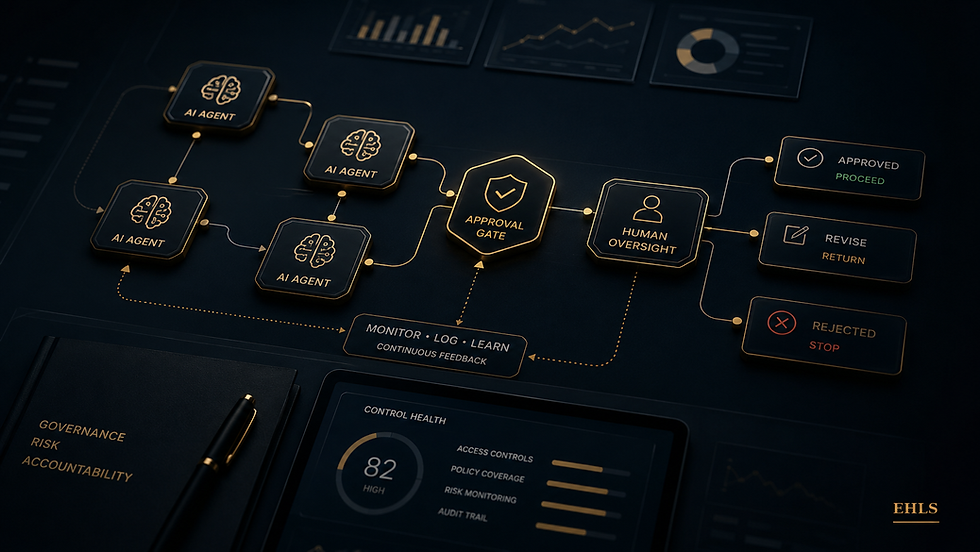
Decision rights should be explicit. The team must know who can approve data access, who defines acceptable output quality, who can change the workflow, who can pause deployment, and who decides whether the initiative advances to the next investment stage. Ambiguity creates delay and encourages local workarounds that weaken both value and control. Clear decision rights reduce meeting volume because routine choices no longer require repeated executive interpretation.
Measure the full value chain
A credible AI ROI system uses leading, operating, and financial indicators. Leading indicators show whether users are adopting the new process and whether the model performs reliably. Operating indicators show whether cycle time, throughput, quality, conversion, or error rates are changing. Financial indicators show whether those improvements affect revenue, cost, margin, working capital, retention, or risk exposure. The three layers make it possible to diagnose why financial value is or is not appearing.
Finance should participate before the pilot begins, not after leadership asks for proof. The baseline, attribution method, benefit assumptions, implementation cost, ongoing operating cost, and confidence level should be documented in advance. Some value will be directly measurable, while other value will require ranges or carefully stated assumptions. The goal is not false precision. The goal is a transparent method that allows executives to compare initiatives and make better capital-allocation decisions.
Use stage gates to prevent endless pilots
A disciplined portfolio moves through defined stages: opportunity validation, controlled pilot, workflow integration, scaled deployment, and ongoing optimization. Each stage should have entry criteria, exit criteria, investment limits, and a decision date. A pilot should not continue simply because the technology is interesting or because a team has invested effort. It should advance only when evidence supports the next level of commitment and the required operating changes are understood.
The stage-gate review should ask whether the operating metric moved, whether the new process replaced work or merely added steps, whether users rely on the output, whether data and control requirements are manageable, and whether the financial case remains credible. These questions turn governance into an engine for speed and focus rather than a compliance delay. Teams know what proof is required, and executives can make decisions without reopening the entire strategy each time.
Design adoption into the business case
AI value is realized through behavior. Training alone is not adoption. Teams need clear expectations, role-specific workflows, trusted data, visible executive support, incentives that reinforce the new process, and rapid resolution of recurring friction. Managers must know how to coach employees using the system and how to distinguish healthy judgment from avoidance. If adoption depends on individual enthusiasm, value will remain uneven and difficult to scale.
The operating model should track where employees bypass the system, correct its outputs, or recreate old work. Those behaviors reveal whether the issue is model quality, workflow design, risk concerns, incentives, or unclear accountability. Treating adoption data as strategic evidence allows leaders to repair the system before declaring that employees are resistant. It also prevents the organization from scaling a technically impressive workflow that users quietly distrust.
Create a recurring executive value review
The executive team should review the AI portfolio on a regular cadence using a concise value dashboard. The review should show investment to date, current stage, accountable owner, operating metric movement, financial value realized, major risks, key assumptions, and the next decision required. It should also identify duplicated capabilities and opportunities to reuse data, platforms, controls, and workflow components across initiatives. Reuse can materially improve returns by lowering the marginal cost of later deployments.
This cadence changes the conversation from enthusiastic updates to capital discipline. It gives leaders permission to expand high-performing initiatives, redesign promising initiatives, and retire work that no longer merits investment. Over time, the company develops an institutional ability to convert AI possibilities into repeatable economic outcomes. That capability becomes more valuable than any single model because it survives technology changes and vendor cycles.
Translate the operating model into the next 90 days
The first 30 days should focus on portfolio visibility and baseline discipline. Inventory active pilots, recurring software costs, internal labor, data dependencies, current owners, and the business outcomes each initiative is expected to influence. Require every initiative to state its value thesis and the evidence needed for the next funding decision. This exercise often reveals duplicate capabilities, orphaned pilots, and projects whose original assumptions are no longer valid. Those findings create immediate opportunities to stop waste and redirect capacity toward higher-value work.
During days 31 through 60, select a small number of priority initiatives and redesign their workflows with the people who perform the work. Establish outcome owners, decision rights, financial baselines, adoption measures, and stage-gate criteria. Confirm that the data, controls, and operating changes required for scale are included in the plan rather than treated as future details. The goal is to create an executable system in which technology, process, accountability, and measurement move together.
During days 61 through 90, run the first executive value review. Compare expected and observed operating changes, identify adoption friction, evaluate the financial mechanism, and decide whether each initiative should scale, be repaired, remain limited, or be retired. Publish those decisions internally so teams understand that AI investment is governed by evidence rather than enthusiasm. Repeating this cycle builds confidence because employees see that leadership rewards useful experimentation while maintaining economic discipline.
The executive test for every AI investment
Before approving the next initiative, ask whether the company can describe the value mechanism in one sentence, name the outcome owner, identify the workflow that will change, establish a baseline, define the decision rights, and specify the evidence required for expansion. If those answers are unclear, the initiative is not ready for a larger budget. It may deserve discovery work, but it should not be represented as a scalable investment.
AI ROI becomes predictable when leadership manages AI as a portfolio of operating-model changes rather than a portfolio of tools. The winners will not necessarily be the companies with the most pilots. They will be the companies that make fewer, better choices; redesign work around those choices; and measure value with enough discipline to scale what works and stop what does not.
Frequently asked executive questions
Why do successful AI pilots fail to produce ROI? They prove a task can be performed but do not redesign the workflow, secure adoption, assign an outcome owner, or connect activity to economics.
Who should own AI value realization? One business outcome owner should be accountable, supported by technology, operations, finance, risk, legal, and change-management leaders.
When should an executive team stop an AI initiative? Stop when evidence thresholds fail, adoption remains weak, economics deteriorate, material risk is unresolved, or no credible path to value remains.
Next executive step
How to Build an AI Value Scorecard the Board Will Trust — rank the portfolio and document which initiatives should be funded, validated, monitored, or stopped.
Use the Executive AI Value Scorecard Toolkit to compare initiatives, test ROI assumptions, review governance readiness, and prepare a board-ready funding recommendation.


Comments