AI Search Visibility: Why Strong Brands Disappear—and How Executives Fix the Gap

Updated: 5 days ago
Executive answer
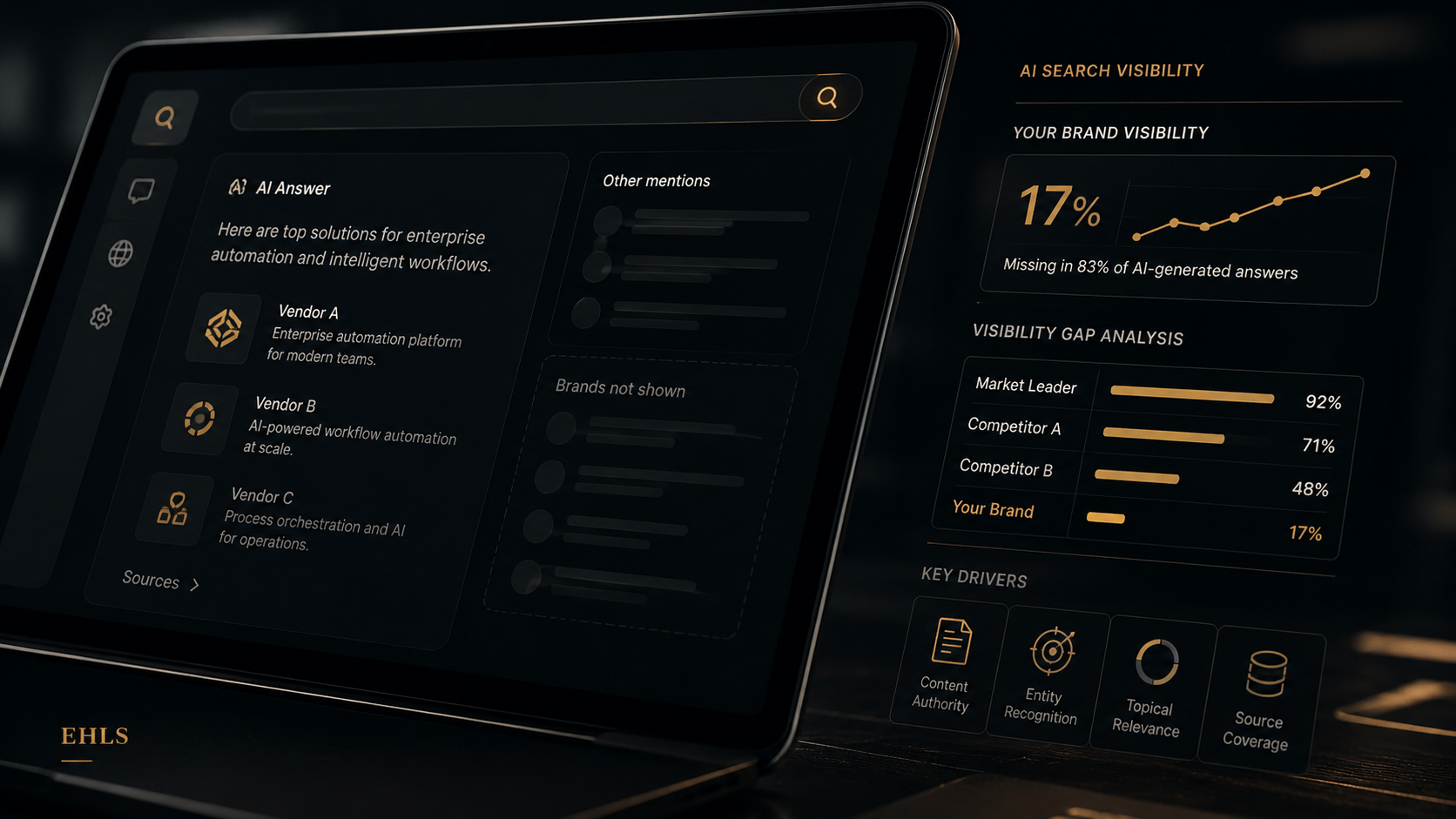
A strong brand can disappear from AI answers when its entity information is inconsistent, its claims lack credible third-party support, or its content avoids the expensive questions buyers ask near a decision. Executive teams should treat AI visibility as a measurable evidence system—not a keyword exercise. Track commercially important prompts, description accuracy, cited sources, competitor inclusion, and qualified-buyer relevance, then strengthen the product truth, external proof, and market authority behind the desired recommendation.
AI search visibility is not traditional SEO with a new label
Traditional SEO remains valuable, but AI-mediated discovery changes the unit of competition. A search result can send a user to several pages and let the user decide what to trust. An AI answer often synthesizes the decision environment before the user clicks. It may name a short list, explain tradeoffs, or recommend a category leader. That means a brand is competing not only for a position on a results page, but for inclusion in the answer and the framing of the decision.
Executives should therefore treat AI visibility as a market-positioning system. The objective is not to manipulate a model. It is to make the brand’s expertise, differentiation, proof, and relevance clear enough that multiple trusted sources can support the same conclusion. This requires coordination across marketing, communications, product, customer experience, data, legal, and executive thought leadership. No single content team can manufacture durable authority alone.
Why recognized brands still disappear
The first reason is entity ambiguity. If the company name, product names, leadership information, categories, locations, and descriptions vary across channels, AI systems may struggle to connect the evidence to one reliable entity. Rebrands, acquisitions, overlapping product names, outdated profiles, and inconsistent descriptions can weaken confidence even when each individual page appears acceptable. Entity clarity is basic infrastructure for both search engines and answer engines.
The second reason is unsupported positioning. A website may claim that a company is innovative, trusted, secure, or the best choice for a particular buyer. Those claims have limited influence when the broader web does not independently support them. AI systems are more likely to repeat conclusions that appear consistently across credible sources and are tied to specific evidence, customers, capabilities, or outcomes. Self-description must be reinforced by external corroboration.
The third reason is content that answers keywords but not buying questions. Many programs produce educational traffic while avoiding the questions decision-makers ask near a purchase: Which option is best for a complex environment? What are the implementation risks? How long does value take? What should the executive team own? What alternatives should be considered? What evidence separates credible vendors from attractive demonstrations? If the brand does not answer those questions, other sources will define the decision context.
Build a machine-readable brand foundation
The foundation begins with a verified entity map. Executive teams should establish canonical names, descriptions, leadership details, product relationships, locations, audiences, and category language. Those facts should be consistent across the website, major profiles, directories, knowledge sources, press materials, partner pages, and structured data. Consistency does not require every description to be identical, but the core identity and relationships should not conflict.
Structured data can help machines interpret the site, but markup cannot compensate for weak external evidence or unclear positioning. Treat it as one layer of an evidence architecture. The website should make important facts easy to locate, connect related pages through logical internal links, and clearly distinguish the company, its products, its people, and its expertise. Every important claim should have a discoverable source of proof.
Own the expensive questions in the category
High-value visibility comes from becoming the most useful answer to costly business questions. The content strategy should be built from recurring executive concerns, procurement objections, implementation failures, financial pressures, governance questions, and competitive tradeoffs. These topics often attract less broad traffic than beginner guides, but they attract stronger intent and create better evidence of real expertise. They also provide a natural path to high-value products, audits, and implementation services.
Each priority question should be supported by a cluster of evidence: an authoritative executive article, an implementation framework, a clear point of view, proof or examples, relevant product documentation, and third-party discussion. The goal is to make the brand’s answer difficult to ignore because it is specific, coherent, and reinforced across formats and sources. One excellent article is useful; a consistent authority system is far more defensible.
Create external corroboration instead of more self-promotion
AI search visibility depends partly on what credible sources say when the company is not controlling the page. Public relations, analyst relations, partnerships, customer advocacy, expert contributions, events, podcasts, reviews, and substantive community participation can all strengthen corroboration. The objective is not to manufacture mentions. It is to create useful evidence that independent audiences choose to reference because it helps them understand a problem or make a decision.
Executives should prioritize source quality and relevance over raw mention volume. A small number of authoritative, context-rich references may carry more strategic value than hundreds of low-quality placements. The strongest external evidence explains what the company does, who it serves, why its approach is credible, and what outcomes or capabilities distinguish it. Vague mentions add little; precise, relevant references strengthen the market’s shared understanding.
Align communications, content, and product truth
A visibility strategy fails when marketing promises one thing, product documentation describes another, sales uses different category language, and customers report a third experience. AI systems can expose those inconsistencies because they synthesize many sources. The remedy is not tighter messaging alone. It is stronger alignment between the brand claim and the delivered experience, supported by current facts and evidence.
Executive teams should identify the few claims they want the market to associate with the company and define the evidence required to sustain each claim. Product, customer success, legal, marketing, and communications should agree on precise language and proof. This creates a repeatable system for producing credible signals rather than a campaign of disconnected content. It also reduces the risk that different teams unintentionally undermine one another.
Measure visibility by commercially meaningful prompts
Executives should not evaluate AI visibility through vanity prompts alone. Build a monitored set of questions that reflects the buyer journey: category education, problem diagnosis, solution comparison, vendor recommendation, implementation planning, risk review, and executive justification. Track whether the brand is mentioned, how it is described, which competitors appear, what sources are cited, and whether the answer reflects the intended positioning. A mention that misrepresents the company is not a complete win.
The prompt set should be segmented by audience, industry, use case, geography, and buying stage where relevant. A company may appear frequently for generic questions but disappear when the prompt includes the exact characteristics of a high-value customer. That difference is commercially important because qualified visibility matters more than broad visibility. The measurement system should prioritize prompts connected to real revenue opportunities.
Turn AI visibility into a cross-functional operating cadence
A monthly executive review can connect visibility data to action. The team should examine important prompt outcomes, emerging buyer questions, cited sources, content gaps, inaccurate descriptions, competitor momentum, and opportunities for stronger proof. Each issue should be assigned to the function capable of improving the underlying evidence—not automatically to the SEO team. Some problems are structural, reputational, product-related, or operational.
Some gaps require new content. Others require updated product information, customer proof, stronger public profiles, clearer category language, technical corrections, communications outreach, or a better market proposition. Treating every visibility problem as a publishing problem leads to more content without more authority. The operating cadence should diagnose the cause before choosing the remedy.
A 90-day executive plan for improving AI search visibility
In the first 30 days, create a visibility baseline around commercially important prompts. Select questions used by executives, evaluators, procurement teams, and sophisticated buyers. Record which brands appear, how they are described, which sources support the answers, and where the company is absent or misrepresented. At the same time, audit entity consistency across the website, profiles, product pages, leadership pages, directories, and major third-party sources. This produces a prioritized list of factual, structural, and authority gaps.
During days 31 through 60, strengthen the evidence around the highest-value gaps. Update canonical company and product information, repair contradictory descriptions, improve structured relationships between pages, and publish executive-level content that answers repeated buying questions. Coordinate with customer success, communications, partnerships, and subject-matter experts to create proof that can travel beyond the company website. Each action should support a specific market conclusion the company wants credible sources to repeat.
During days 61 through 90, measure prompt-level changes and source movement. Look for improvements in inclusion, description accuracy, cited evidence, category association, and qualified buyer relevance. Do not expect every answer engine to change simultaneously or permanently. Use the results to identify which evidence is being recognized, which competitors are gaining authority, and which gaps require product truth, customer proof, or external validation rather than additional articles.
The executive advantage is evidence density
Brands that win AI-mediated discovery will create a dense, consistent network of useful evidence around the problems they solve. They will be clear about who they are, answer the questions that matter financially, earn credible external validation, and align their claims with customer reality. That system improves traditional search, public reputation, sales enablement, and AI recommendations at the same time.
The visibility gap is fixable, but it cannot be solved by adding a few keywords to existing pages. It requires executive ownership of the brand’s evidence environment and a disciplined process for improving the signals that shape modern buying decisions. The companies that treat this as a strategic operating system will be better positioned than those that wait for traffic reports to reveal the loss.
Frequently asked executive questions
Why is a strong brand missing from ChatGPT or other AI answers? Common causes include inconsistent entity data, weak external corroboration, limited category authority, and missing content for high-intent buying questions.
How is AI visibility different from traditional SEO? Traditional SEO ranks pages; AI systems synthesize evidence, frame tradeoffs, and may create a shortlist before the buyer clicks.
How should executives measure AI-search visibility? Track a fixed prompt set by buyer stage, brand inclusion, description accuracy, cited sources, competitor presence, and relevance to qualified buyers.
Next executive step
How to Build an AI Value Scorecard the Board Will Trust — evaluate whether an AI-visibility initiative deserves capital, ownership, and executive attention.
Use the Executive AI Value Scorecard Toolkit to evaluate AI visibility as an investment, compare it with competing initiatives, and document the expected value, readiness, and risk.



Comments