Map Your Voice
Capture how you explain, teach, guide, and communicate.
Create your first AI twin by turning your voice, knowledge, style, and ideas into content, digital products, guides, prompts, templates, and simple offers.
Create Your Digital ProductCapture how you explain, teach, guide, and communicate.
Decide what your AI twin or avatar should help people understand, create, or do.
Use your AI twin to create content, resources, products, and simple offers.
Turn your knowledge into a paid digital product with a practical step-by-step system for choosing the idea, organizing the content, designing it, and preparing it to sell.
Get Create & Cash In for $37Draft blog posts, captions, and educational emails that sound like you.
Create guides, templates, and courses using your unique knowledge.
Create paid guides, templates, prompt packs, and resources built around one clear problem your audience wants solved.
Answer frequent questions and guide new students through your methods.
Turn complex ideas into simple frameworks people can actually use.
Establish easy workflows for showing up and sharing your expertise consistently.
AI Creators Academy is optional support for people who want mentorship, community, feedback, and personalized help while building their AI twin and related digital products.
Get guidance as you shape your AI twin’s voice, purpose, personality, and content direction.
Ask questions, share progress, and connect with others building AI twins and digital products.
Get help applying the tools to your own brand, ideas, products, and offers.


Updated: 5 days ago
Professionals can use AI to organize expertise without giving up the judgment, experience, and personal perspective that make their work valuable. For professionals who've already mastered their craft, the real challenge isn't learning new tools—it's maintaining control over your unique voice while scaling your expertise. This guide shows how to leverage AI as a strategic organizing assistant without sacrificing your judgment, experience, or authentic perspective. We'll focus on practical, human-centered implementation that respects your professional identity.

When professionals first encounter AI tools for knowledge management, they often react with caution. The fear isn't about the technology itself but about losing the personal touch that makes expertise valuable. Unlike simple productivity apps, AI organizing systems require thoughtful integration to preserve your professional voice. This isn't about replacing your judgment—it's about enhancing your ability to synthesize information while keeping your unique perspective central to the process.
Define Your Core Expertise Boundaries
Before implementing any AI tool, clarify what your expertise truly encompasses. This prevents over-organization and maintains focus on your unique value proposition. By establishing clear boundaries, you ensure AI assists in relevant areas without diluting your professional identity. Implement Selective Data Curation
Use AI to identify and prioritize information that aligns with your expertise boundaries. This means filtering out irrelevant data while highlighting high-value insights. A marketing consultant could use AI to scan industry reports and client interactions to surface actionable trends without drowning in noise. Maintain Your Final Review and Decision Authority
The most critical step is preserving your final say. After AI processes information, you review and validate outputs before finalizing decisions. This ensures your expertise remains the ultimate decision-maker, not the tool.
A certified project manager uses AI to categorize past project documentation, identifying patterns in team communication and risk management. This helps them quickly reference best practices without re-creating knowledge from scratch. The AI organizes the data, but the project manager decides which patterns to apply to new projects.
A medical researcher leverages AI to synthesize recent clinical studies, highlighting gaps in current literature that align with their specific research focus. They use the AI output to identify potential collaboration opportunities without letting the tool dictate their scientific judgment.
An experienced copywriter employs AI to analyze client feedback and competitor content, then uses the insights to refine their unique writing style. The AI provides data-driven suggestions, but the copywriter maintains control over the final tone and messaging.
Identify your expertise boundaries — What specific knowledge areas do you own?
Set clear AI usage parameters — What types of information should AI process?
Establish review protocols — Who reviews AI outputs before final action?
Track your decision patterns — How often do you override AI suggestions?
Measure voice retention — Do your outputs still reflect your unique perspective after AI processing?
Adjust boundaries as needed — When AI reveals gaps in your expertise, refine your focus.
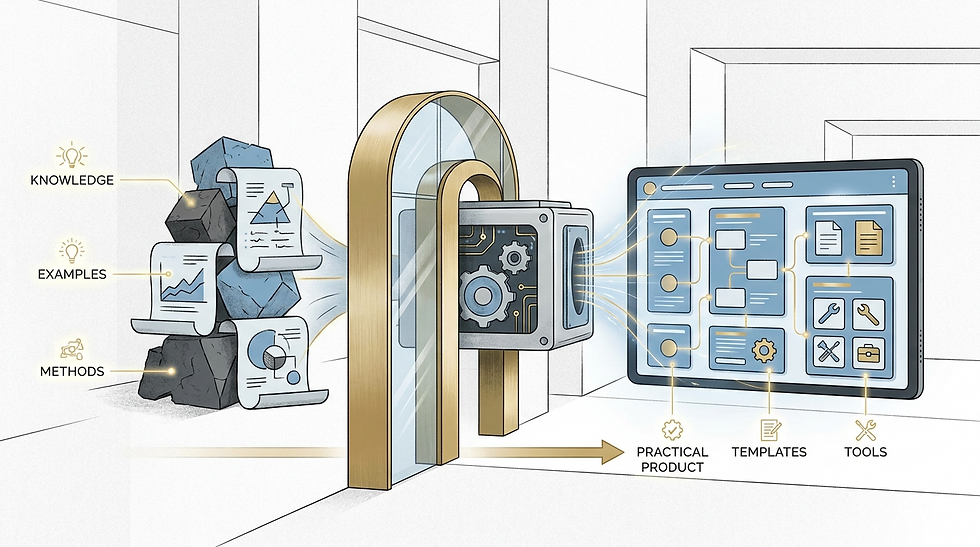
Start with your original notes, client observations, examples, and ideas. Give those materials to AI for grouping, outlining, and identifying repeated themes or missing information. Keep the judgment, examples, conclusions, and final wording human-led, then review the result for voice, accuracy, confidentiality, and context. For example, scattered client notes can become an organized outline, but your interpretation of what matters—and the language used to explain it—should remain yours.
After generating content, run this quick self-review to ensure your AI output feels authentically yours: First, read aloud. Does the phrasing flow naturally—like how you’d explain it over coffee? Second, verify personal examples remain specific and unaltered; replace vague references like "many clients" with concrete instances from your work.
Third, cross-check all claims against your actual experience—AI often overstates results. If you say "this method doubled engagement," confirm it happened in your real projects. Fourth, hunt for generic phrases like "this approach is effective" and swap them with tangible details: instead of "streamlining processes," try "reducing client onboarding steps from 12 to 5 after we eliminated redundant forms."
Fifth, ensure the conclusion reflects your unique perspective, not AI’s logical endpoints—does it sound like *you* would judge the outcome? Finally, scrub any confidential client names, data, or project specifics before sharing. This process keeps your voice grounded in real-world context while maintaining professionalism.
1. Can AI help me organize knowledge without losing my unique perspective? Yes. By focusing on your specific expertise boundaries and maintaining final review authority, AI can enhance your knowledge organization while preserving your voice.
2. How do I know if AI is adding value or just noise?
Start with a small test. Use AI to analyze one type of data relevant to your expertise, then compare the output against your existing knowledge. If the insights align with your experience, it's adding value.
3. Should I trust AI more or less than my own experience?
Never let AI override your professional judgment. The goal is to use AI as a tool that supports your expertise, not replaces it. Your experience remains the ultimate decision-maker.
4. What if AI suggests a solution that contradicts my expertise?
This is normal. The key is to review the AI output critically and determine whether the suggestion aligns with your expertise. If not, you override it—this is where your voice remains strong.
5. How often should I review AI outputs?
At least once per significant decision. For routine tasks, a quick check before finalizing is sufficient. The frequency depends on the importance of the decision and your expertise level.
This framework addresses the core concern of professionals: maintaining control over their expertise while leveraging AI for efficiency. By focusing on your unique value proposition and preserving decision authority, you avoid the common pitfalls of over-reliance on AI. The result is a more strategic use of technology that enhances—not diminishes—your professional identity.
By treating AI as a strategic organizing assistant rather than a replacement for your expertise, you can maintain control over your voice while scaling your knowledge management. The key isn't avoiding AI but using it intentionally to support your professional judgment. This approach ensures that your expertise remains the foundation of your work, not the tool.
Ready to organize your expertise into a practical digital product? Explore Create & Cash In.
Ready to turn this into a real digital product? Create & Cash In gives you a focused path from idea to finished offer.
Once your expertise is organized, the next challenge is giving your audience a clear place to learn, ask questions, and keep moving. See how course creators can build an AI-powered community with Skool.


Comments