AI Portfolio Management: How Executives Decide Which AI Projects to Fund, Fix, or Kill

Updated: 5 days ago
AI spending is accelerating faster than many leadership teams can prove its value. That creates a portfolio problem, not merely a technology problem. Executives are no longer deciding whether the company should use AI. They are deciding which initiatives deserve another dollar, which need intervention, and which should stop before they consume more budget, attention, data access, and change capacity.
That distinction matters because individual project teams naturally optimize for their own initiative. A sponsor can point to a successful pilot, an impressive model demo, or an enthusiastic user group and still fail to answer the harder capital-allocation question: compared with the other AI initiatives competing for the same resources, is this one still the best place to invest?
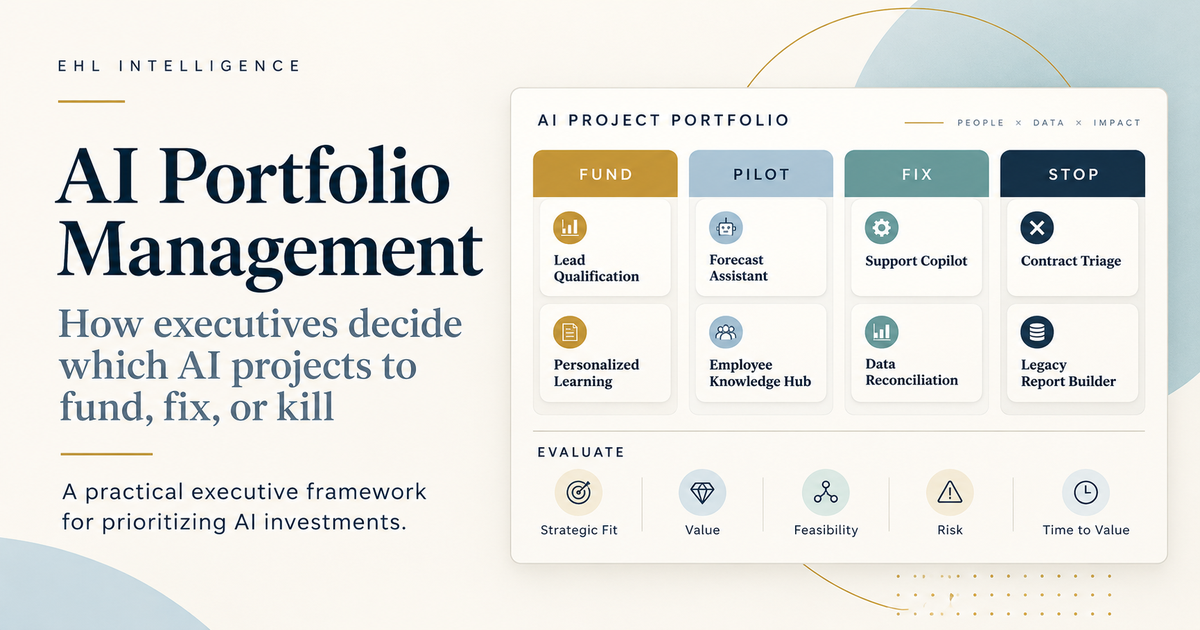
AI portfolio management creates a common decision system across initiatives. It gives leaders a repeatable way to compare strategic fit, financial value, execution readiness, risk, and time to value. The goal is not to rank every project with artificial precision. The goal is to make funding decisions with enough discipline that weak initiatives do not survive simply because they have momentum.

Why AI has become a portfolio problem
The market is already exposing the gap between AI activity and enterprise value. Gartner reported in September 2026 that only 22% of surveyed organizations had successfully scaled AI across multiple business units or adopted an AI-first approach, even as 85% of functional leaders planned to increase AI spending. Gartner also found that high performers constantly track ROI, treat AI as a portfolio of value, regularly assess project performance, and reallocate or discontinue underperforming initiatives. Those high performers reported positive returns in 81% of their AI initiatives.
PwC found a similarly concentrated pattern: among 1,217 organizations it studied, the top 20% captured 74% of AI-driven returns. The implication is important. More AI activity does not automatically produce more AI value. The advantage comes from how leaders choose, govern, measure, and reallocate investments.
That is why a list of pilots is not an AI portfolio. A portfolio has explicit selection criteria, comparable economics, owners, review dates, stop conditions, and rules for reallocating resources. Without those controls, the company can end up funding many locally reasonable projects that collectively create a weak return.
The board's real question: where should the next dollar go?
A project business case asks whether one initiative can create value. Portfolio management asks a more demanding question: where should the next dollar, engineering hour, executive sponsor, data-science resource, or change-management effort go?
That question forces comparability. One team cannot present optimistic revenue upside while another uses conservative cost savings and expect leadership to make a clean choice. Initiatives need a common time horizon, a consistent definition of cost, agreed benefit categories, and comparable confidence levels.
The same discipline applies to risk. A high-return use case that touches regulated data, makes customer-facing decisions, or depends on unstable vendor economics may deserve a different funding path from a lower-risk internal workflow. Portfolio decisions become stronger when value and risk are evaluated together rather than in separate meetings.
If your organization is still evaluating projects one at a time, start with How to Build an AI Value Scorecard the Board Will Trust to establish a consistent scoring foundation before comparing the portfolio.
Use five dimensions to compare AI investments
A practical executive scorecard can compare initiatives across five dimensions: strategic alignment, value potential, feasibility and readiness, risk and governance, and time to value.
Strategic alignment: Does the initiative materially advance an approved business priority such as growth, margin, customer experience, resilience, or operating capacity?
Value potential: What measurable economic outcome is expected, how credible are the assumptions, and does the model include the full cost of ownership?
Feasibility and readiness: Are the data, integrations, process changes, adoption conditions, operating ownership, talent, and vendor dependencies strong enough to deliver?
Risk and governance: Are privacy, cybersecurity, intellectual property, compliance, model behavior, human oversight, auditability, and shutdown authority acceptable?
Time to value: How quickly can leadership obtain meaningful evidence, and how long until cumulative benefits justify the investment?
Two projects with similar expected ROI may deserve different priorities if one can produce reliable evidence in 60 days and the other requires eighteen months before the key assumptions can be tested. The score should make those tradeoffs visible before the next budget commitment.
For the financial layer, use the same assumptions and payback logic across initiatives. This executive AI ROI calculator guide explains how to compare projects on a consistent economic basis.
Turn the score into a fund, scale, fix, or kill decision
The score is useful only if it changes a decision. A simple portfolio review can place each initiative into one of four actions: fund, scale, fix, or kill.
Fund: the initiative has enough evidence to justify the next controlled investment. Funding is tied to the next measurable milestone, not an unlimited commitment.
Scale: the initiative has demonstrated value and operating readiness strongly enough to expand, with governance, monitoring, adoption, and unit-economics checks remaining active.
Fix: the business case may still be attractive, but a specific weakness blocks additional scale. The fix gets a deadline and a measurable return-to-funding condition.
Kill: the initiative no longer has a credible path to sufficient value relative to alternatives. Resources are released for stronger opportunities.
Stopping an initiative is capital discipline. A portfolio improves when leadership can move resources from deteriorating opportunities to stronger ones.
Define kill criteria before the project gains political momentum
One of the most valuable governance moves is to define stop conditions before a project becomes politically expensive to cancel. Once a team has spent months building an initiative, sponsors and operators can become attached to preserving it. Predefined kill criteria reduce that bias.
Useful kill criteria include failure to meet a minimum quality threshold, unresolved privacy or security exposure, implementation cost rising beyond an approved range, adoption remaining below the level required for the economics to work, vendor pricing making the operating model unattractive, or the underlying business priority changing.
Kill criteria should be specific enough to trigger a decision. “Low adoption” is vague. “Fewer than 35% of target users complete the new workflow weekly after two remediation cycles” is actionable. “Costs are too high” is vague. “Expected payback moves beyond 24 months after validated implementation and run-rate costs are included” creates a decision boundary.
Predefined criteria also improve sponsor behavior. Teams know what evidence matters, finance knows when assumptions must be refreshed, and risk leaders know which unresolved issues can block expansion.
Review the portfolio on a fixed cadence
Portfolio management fails when scoring happens once and the spreadsheet disappears. The scorecard should be refreshed at defined decision points: before pilot funding, after the first evidence cycle, before production rollout, and at recurring portfolio reviews for material initiatives.
For fast-moving AI programs, a monthly operating review with a deeper quarterly capital-allocation review is often more useful than an annual planning exercise. The cadence should match the size and volatility of the investments, but every review should answer the same core questions: What changed? What evidence improved or weakened? Which assumptions are now wrong? Which risks changed? What resources should move?
Deloitte's 2026 CFO Signals research shows why this discipline matters. CFOs reported pressure to deploy AI quickly while managing risk, and 46% cited cost uncertainty or lack of transparency as their biggest internal AI concern. A portfolio review creates a place where cost, value, risk, and strategic priority are considered together rather than in separate functional conversations.
Reallocate capital instead of protecting sunk costs
The most important portfolio behavior is reallocation. If leadership never removes funding from a weak initiative, the scoring process is ceremonial.
Reallocation can mean moving budget, people, data-engineering capacity, executive attention, or vendor commitments. It can also mean narrowing one initiative so another can move faster. The decision should follow forward-looking value, not money already spent.
A useful executive question is: if this project did not already exist, would we fund it today at its current cost, evidence level, and risk profile? If the answer is no, sunk-cost thinking may be keeping it alive.
High-performing AI organizations make this logic routine. They do not treat every pilot as a promise to reach production. They treat each stage as an option to invest more only when the evidence earns it.
If projects are stalling between pilot and measurable value, read AI ROI: Why Investments Stall—and the Executive Operating Model That Fixes It for the operating-model layer behind portfolio decisions.
A simple executive decision table
Imagine three initiatives competing for the same budget.
Initiative A has strong strategic alignment, measurable revenue upside, clean data access, manageable risk, and evidence expected within one quarter. It belongs in the fund or scale lane.
Initiative B has strong potential but poor adoption and a cost model that is not yet reliable. It belongs in the fix lane with a short deadline, an adoption target, and a refreshed cost model before any additional rollout.
Initiative C has modest expected value, a long integration timeline, unresolved privacy concerns, and no executive owner for the business outcome. Even if the prototype works, it may belong in the kill lane because stronger alternatives exist.
The point is not that every project can be reduced to a single number. The point is that a common scorecard makes the tradeoffs visible. Leadership can see why one initiative earns more capital while another does not.
What strong AI portfolio governance looks like
Strong portfolio governance has a few recognizable characteristics. Every material initiative has a named business outcome owner. Financial assumptions have an accountable reviewer. Risk requirements are visible before scale. Evidence thresholds are written down. Review dates are scheduled. Stop conditions exist. Decisions are recorded. Resources can actually move.
The portfolio also separates experimentation from commitment. Early exploration can be inexpensive and broad, but production funding should become progressively more demanding. As the investment grows, the evidence standard should rise.
This protects innovation rather than slowing it. Teams can test ideas without pretending every test deserves enterprise rollout. Executives can support experimentation while maintaining capital discipline. Finance and risk leaders can engage at defined gates instead of arriving after momentum has already made the decision.
For the control layer, pair the portfolio review with The Executive AI Governance Checklist so risk and readiness gates stay visible alongside ROI.
Make the next budget review a portfolio decision
Executives do not need another dashboard that reports how many AI pilots are active. They need a decision system that identifies which initiatives deserve more funding, which require correction, which are ready to scale, and which should stop.
Start by placing the serious AI initiatives into one portfolio, scoring them against the same five dimensions, documenting the major assumptions, and assigning a next decision date. Then force each review to end with an action and an owner.
If you already have individual AI business cases but struggle to compare them, the missing layer is portfolio discipline. The goal is better allocation decisions—not perfect predictions or persuasive slide decks.
Use one system to compare AI investments before the next budget review
If you need a repeatable way to compare AI initiatives before the next budget review, the Executive AI Value Scorecard Toolkit gives you the editable scorecard, ROI and payback calculator, governance and readiness checklist, 90-day roadmap, executive summary template, board presentation template, and completed example in one system.


Comments