Topic Cluster Strategy: Turn One Strong Blog Post Into Search-Driven Growth

A topic cluster strategy turns one proven article into a connected set of useful pages that support search growth and a clearer reader journey. The fastest way to grow a useful blog is not always to chase a brand-new topic. Often, the better opportunity is already visible in a post that attracts search impressions, earns clicks, keeps readers engaged, or leads naturally to a relevant offer. That post can become the center of a focused topic cluster.
A topic cluster is a group of connected articles that answer different parts of the same reader problem. The goal is not to publish several posts that repeat the same advice. The goal is to cover the decision, process, examples, mistakes, tools, and next steps around one clear search intent.
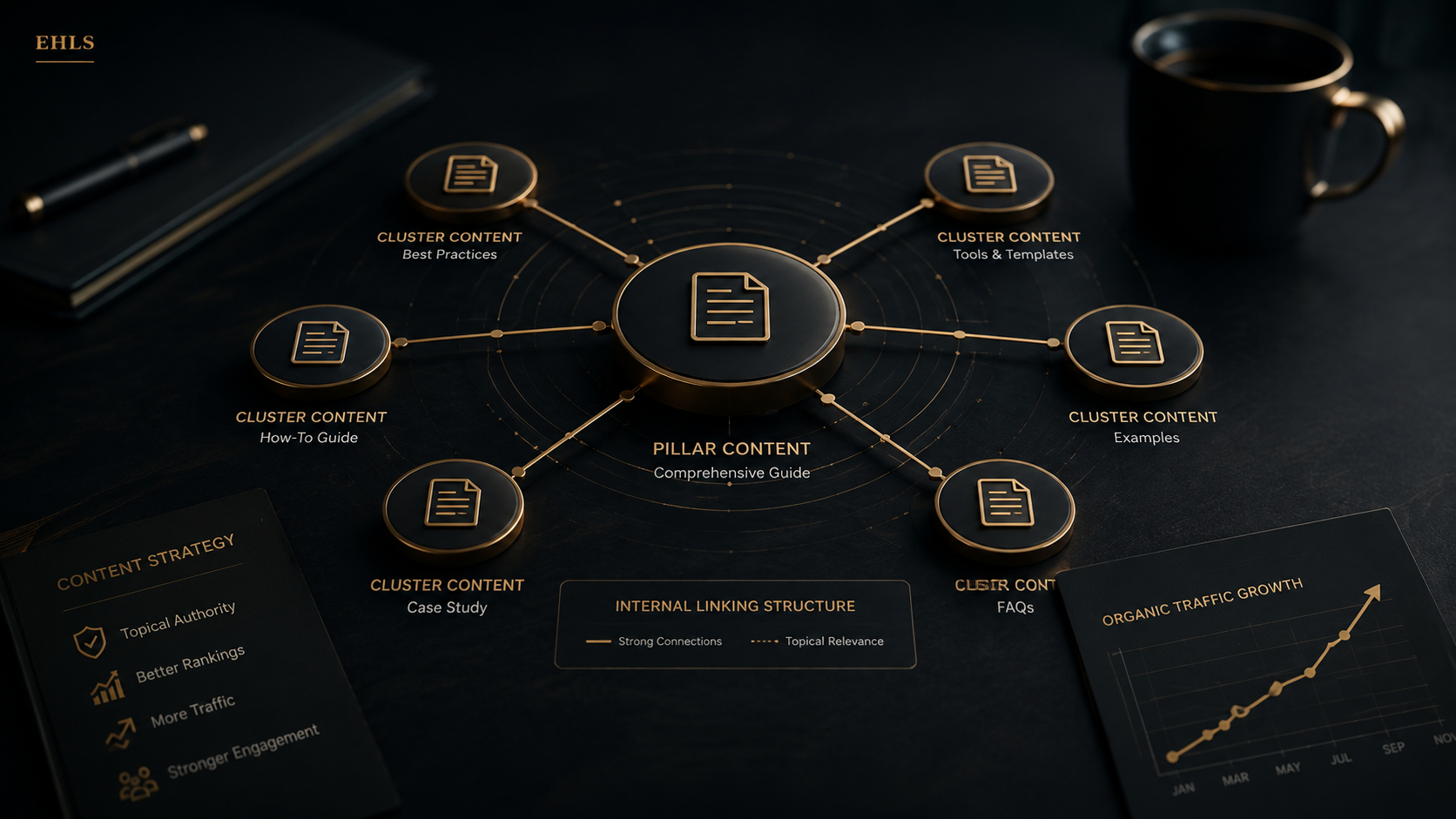
Start your topic cluster strategy with the strongest post
Start with evidence you can trust. Look for a published article that receives meaningful search impressions, ranks for several related terms, earns internal clicks, or supports a business goal. If your analytics are incomplete, use the best verified signals available and mark the missing data instead of inventing performance.
The best cluster center is usually broad enough to support several useful subtopics but focused enough to attract one type of reader. A guide about creating digital products with Canva and ChatGPT, for example, can support articles about choosing a product format, writing with AI without losing your voice, creating templates, reviewing the final product, and pricing the offer.
Map the reader’s follow-up questions
Read the main article as if you were a beginner. After each section, ask what the reader would need to know next. Questions that deserve more than a short paragraph are strong supporting-post candidates.
Organize the questions into four groups: getting started, completing the process, avoiding mistakes, and improving the result. This gives the cluster range without making it unfocused. Each supporting post should solve one distinct problem and link back to the central guide.
Assign a unique job to every article
Before drafting, write one sentence that defines the job of each post. One article may help the reader choose between a workbook and a template. Another may explain how to create a useful outline. Another may show how to test demand before building. If two article jobs sound almost identical, combine them or sharpen the difference.
A clear job also improves the headline. Search-focused headlines should reflect the reader’s question in natural language. Avoid forcing several keywords into one title. The article should be easy to understand before it tries to be clever.
Build internal links that explain the next step
Internal links are most useful when the surrounding sentence explains why the linked article matters. Link from the central guide to each supporting article at the point where the related question appears. Link from every supporting article back to the central guide and to one logical next step.
Update older related posts too. A topic cluster becomes stronger when the links work in both directions and readers can move through the subject without returning to the main navigation.
Use a consistent long-form structure
Supporting articles should open with the specific problem, explain who the advice is for, and quickly show the outcome. Use descriptive headings, practical examples, and a short action step at the end. Depth matters, but unnecessary repetition does not. Every section should either answer a question, reduce confusion, or help the reader act.
Refresh the central post as the cluster grows
Do not leave the original article unchanged while adding new supporting content. Update its examples, clarify weak sections, add links to the new posts, and make sure the main promise still matches the search intent. A strong cluster center should become more useful over time.
Measure the cluster as a system
The purpose of a topic cluster is not simply to produce more pages. It is to create a connected body of content that answers a complete set of questions better than one isolated article can.
Your next step
Choose one published post with the clearest verified search opportunity. Write down six follow-up questions, group them by reader stage, and select the three that solve the most distinct problems. Those three supporting articles become the first expansion of the cluster.
Turn this strategy into a paid offer
Ready to put this into action? Explore Create & Cash In for a focused path from idea to a finished digital product you can sell.


Comments